Source: http://blogohj.oralhealthjournal.com/uncategorized/healthy-lunches-for-a-new-school-year
dental extraction dentist implants implants dentist teeth implants cost dental works
Source: http://blogohj.oralhealthjournal.com/uncategorized/healthy-lunches-for-a-new-school-year
dental extraction dentist implants implants dentist teeth implants cost dental works

dental extraction dentist implants implants dentist teeth implants cost dental works

dental solutions oral dentist surgery oral surgery dentist dentist oral surgery dental implant surgery
what are dental implants implants dental dental services implant dental dental implant
dentures dental implants what are dental implants implants dental dental services
Superficial irregularities and certain intrinsic stains on the dental enamel surfaces can be resolved by enamel microabrasion, however, treatment for such defects need to be confined to the outermost regions of the enamel surface. Dental bleaching and resin-based composite repair are also often useful for certain situations for tooth color corrections.
dental oral surgery dentalimplants maxillofacial surgery implants teeth teeth implants


Source: http://feedproxy.google.com/~r/TheDentalImplantBlog/~3/NWITlOwpTeA/
oral tooth surgery sedation dentistry crown tooth dental bridge jaw surgery

oral dental surgeon dental oral surgeon facial surgery dental oral surgeons maxillofacial surgeon
Source: http://www.omfdental.com/blog/2014/sticky/?utm_source=rss&utm_medium=rss&utm_campaign=sticky
dental extraction dentist implants implants dentist teeth implants cost dental works
dental implant procedure dental implants surgery dental implants procedure tooth implant surgery oral surgery teeth

dental extractions implant dentures gum surgery maxillofacial jaw surgery wisdom tooth removal cost

Source: http://feedproxy.google.com/~r/BeautyFromAfar/~3/o_pxR8cSq1Q/
dental services implant dental dental implant oral surgeon tooth extraction

Source: http://feedproxy.google.com/~r/BeautyFromAfar/~3/0GaNIJe9ZWw/
dental oral surgery dentalimplants maxillofacial surgery implants teeth teeth implants
sedation dentistry crown tooth dental bridge jaw surgery implant dentist
Back when I was in dental school, the instructors told us to always pull back on the anesthetic syringe before injecting. By doing this, we would make sure that we weren't injecting the anesthetic into a blood vessel, which would cause the epinephrine in the anesthetic to make the patient's heart feel like it was beating out of their chest.
They called this the epinephrine reaction, and I blindly believed it. I even wrote a post about why dental anesthetic makes your heart beat faster. Until one day, this belief was questioned by a comment on that article (which actually caused Gavin to post a rather entertaining comment). I realized that I'd blindly believed what I'd been taught without doing any research of my own.
In this follow-up article, I'll answer the question: Can dental anesthetic really make your heart beat faster?
A few weeks ago, a woman told me that she hates getting injections because it makes her heart beat really fast. I asked her if a dentist had ever offered her the anesthetic brand Carbocaine (a type of dental anesthetic without any added epinephrine). She told me that she'd never heard of it. I tried it on her and she told me that it was the first injection she could remember where she didn't feel like her heart was beating out of her chest.
Naturally, this (along with other similar experiences) made me a believer that regular dental anesthetic with epinephrine can indeed make your heart beat faster. As a dentist I realize that stories, while fun and exciting, may not be a very good source of evidence, so I decided to do some more in-depth research.
The main question here is whether or not the small amount of epinephrine inside the dental anesthetic makes your heart beat faster or if it's simply caused by the epinephrine your body releases in response to being afraid of the crazy dentist that's about to poke you.
Many years ago, it was thought that the tiny amount of epinephrine in the dental anesthetic made no difference in your heart rate, and any change in your heart rate was simply caused by the "fight or flight" response.
Many studies have since confirmed that the epinephrine in dental anesthetic can cause an increase in your heart rate.
One study states that "intravenous administration of 0.015 mg of epinephrine with lidocaine results in increase in the heart rate ranging from 25 to 70 beats per minute, with elevations in the systolic blood from 20 to 70 mm Hg." For your information, one cartridge of dental anesthetic contains 0.018 mg of epinephrine — that's even more than the amount that has been shown to increase the heart rate by 25 to 70 beats per minute. Here's a link to one of those studies that discusses this.
Malamed's dental textbook on anesthetic even confirms what I'd discovered. It says, "Contrary to a previously held position that the intraoral administration of "usual" volumes of epinephrine produced no cardiovascular response and that patients were more at risk from endogenously released epinephrine than they were from exogenously administered epinephrine, recent evidence demonstrates that epinephrine plasma levels equivalent to those achieved during moderate to heavy exercise may occur after intraoral injection."
That simply says that the epinephrine in dental anesthetic can make your heart beat very fast, even tricking it into beating as fast as it would if you were exercising.
The author goes on to state that even if your dentist does inject slowly and "pull back" to ensure that they don't inject into a blood vessel, your heart can still beat faster: "However, even following usual precautions (e.g. aspiration, slow injection), sufficient epinephrine can be absorbed to cause sympathomimetic reactions such as aprehension, tachycardia, sweating, and pounding in the chest (palpitation): the so-called "epinephrine reaction."
Even more evidence that dental anesthetic can make your heart beat faster comes from the American Heart Association. They recommend that any patients with heart disease receive a maximum of 0.04 mg of epinephrine from dental anesthetic. That's usually the equivalent of just two cartridges of dental anesthetic. For comparison's sake, a normal person without heart disease can receive up to eleven cartridges of anesthetic.
This shows that the AHA believes that the epinephrine in dental anesthetic can have an effect on the heart, and that's why they recommend limiting it so strictly.
The textbook Dental Management of the Medically Compromised Patient confirms this by stating "If [a vasoconstrictor] is considered essential, use cautiously (maximum 0.036 mg epinephrine or 0.20 mg levonordefrin)." Levonordefrin is similar to epinephrine, but it is mostly used in European countries, not in the U.S.
Lastly, the American Acamedy of Pediatric Dentists even has guidelines for dentists telling us what to do when a patient has a reaction to the epinephrine in dental anesthetic. They say to reassure the patient, ensure they're breathing well, and to check their vital signs if necessary.
In summary, the most recent studies and evidence all point to the fact that the epinephrine (or levonordefrin for my European friends) can definitely make your heart feel like its beating out of your chest!
Do you have any questions about dental anesthetic and how it affects your heart? Feel free to leave them in the comments section below. Thanks for reading!


Source: http://feedproxy.google.com/~r/OralAnswers/~3/PoL8vVo3394/
dental implants what are dental implants implants dental dental services implant dental
Catherine recently left a comment asking about the discolored lines that she has running vertically in her front teeth. She was curious about what kinds of solutions there are to deal with this cosmetic problem.
Before I talk about the solutions to these lines that can occur in our teeth, I'll give an overview of what they are, why they happen, and how to get rid of them.
These vertical lines in her front teeth are actually known as craze lines. Over years of use, our teeth tend to develop tiny cracks in the hard outer layer known as enamel. These cracks normally don't cause any pain, but can easily stain, causing embarrassing discolored lines on your front teeth.
Craze lines can be caused by stress placed on a tooth. This can happen over the course of a lifetime of chewing or by any other process that causes a lot of stress on our teeth.
Some common causes of craze lines are biting your nails, grinding your teeth (many people do it in their sleep without realizing it), using your teeth as tools, trauma to your teeth, or simply routine use of your teeth.
In Dr. Cohen's textbook about root canals, he states, "Craze lines are merely cracks in the enamel that do not extend into the dentin and either occur naturally or develop after trauma."
This case report describes a situation where craze lines were caused by biting on hard objects such as the top ring of an aluminum soda pop can. Speaking of metal rings, wearing tongue rings can cause craze lines in your teeth.
Interestingly, some research points to temperature changes as a possible cause of craze lines. That's a great incentive to not chew ice cubes (especially after drinking hot coffee!)
One other cause of craze lines that should be discussed is going to the dentist. This research article states that he process of drilling away a cavity and filling a tooth can cause craze lines. That's certainly not a reason to avoid the dentist, though, since craze lines are harmless whereas untreated cavities can lead to significant complications.
Although craze lines are very tiny cracks in the outermost layer of your tooth, you don't need to worry about your tooth cracking in half.
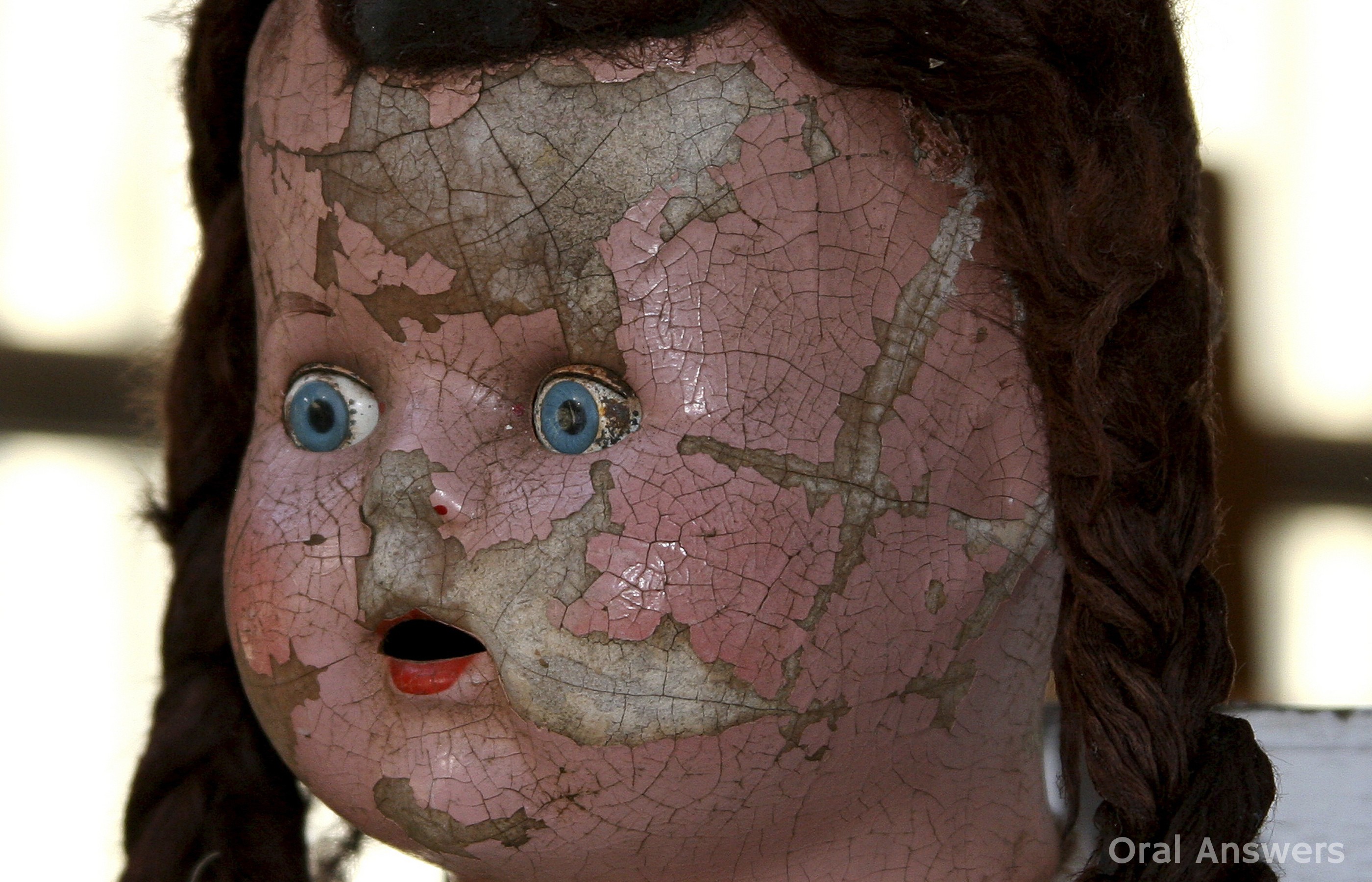
One good way to think about craze lines is to take a look at the above photo of this porcelain doll. The cracks in the porcelain occurred after years of use. Although they are cosmetically displeasing, the cracks don't mean that the doll's head is about to crack open!
If you suffer from craze lines, you'll be pleased to know that the way that our teeth forms makes the enamel highly resistant to cracking.
A recent study looked at the crack resistance of the enamel in our teeth compared to a synthetic enamel. The study concluded, "While enamel is the most highly mineralized tissue of the human body, the microstructural arrangement of the prisms promotes exceptional resistance to crack growth."
If that isn't enough, this study says that "The microstructure of enamel is functionally optimized to guide cracks from the more brittle outer enamel inwards where they experience higher growth resistance and are prevented from causing fracture and chipping."
This study found that enamel is about three times as tough as the naturally-occurring crystals of hydroxyapatite (the crystal that our tooth is made from.)
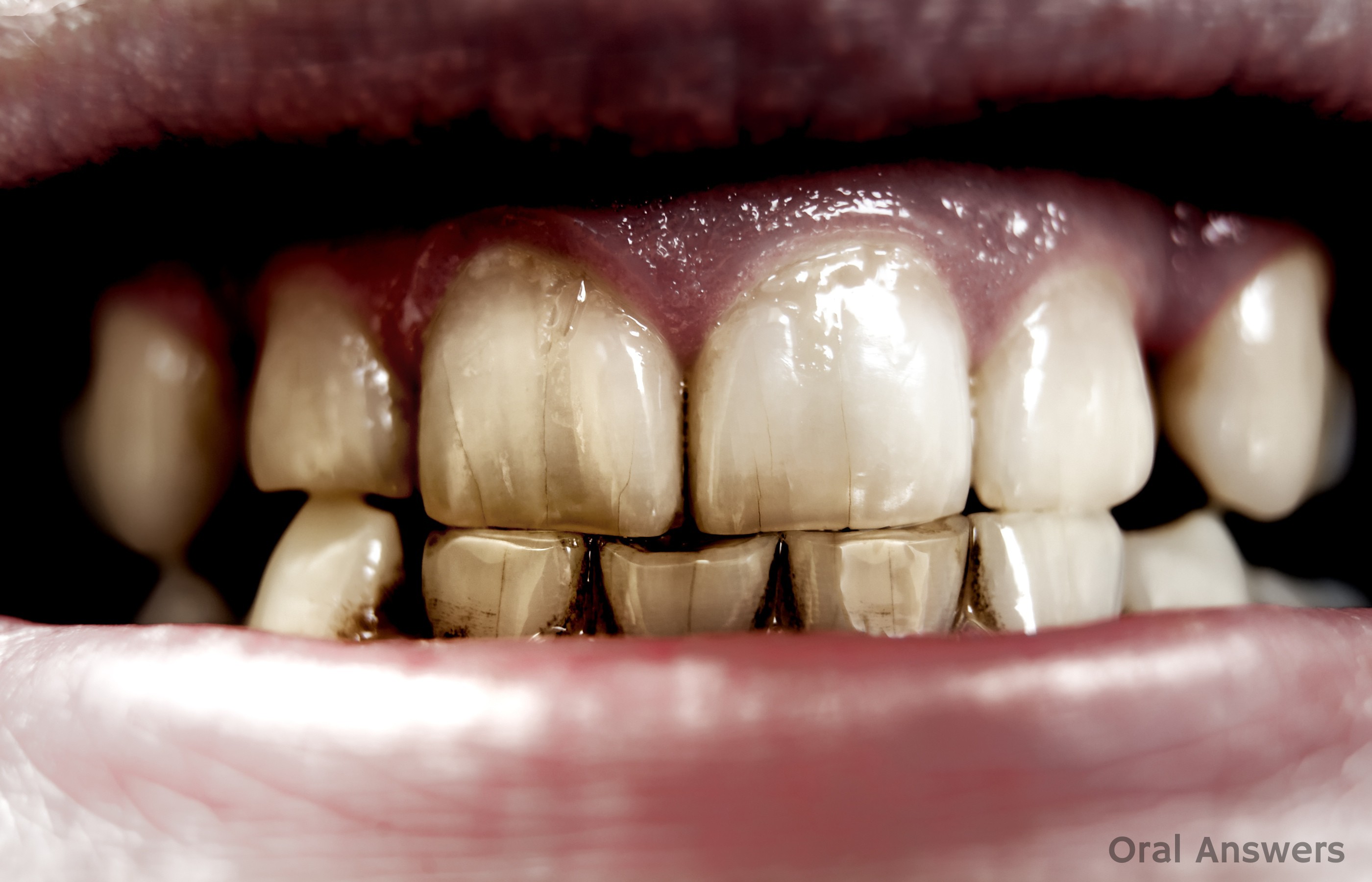
Enhanced image of stained teeth to emphasize prominent craze lines
So, what should you do if you have craze lines and you hate how they look? There are a few alternatives.
The least invasive option is to try teeth whitening. Many craze lines show up because tiny amounts of debri get into the crack and stain the crack, making it visible. Teeth whitening can bleach away the stain and make the craze lines very hard to detect.
There are other options that involve actual dental work. Before trying these options, it's good to keep in mind that craze lines can be caused by dental work, and that no dental work is better than your natural teeth.
These options include having an aesthetic tooth-colored filling material placed over the crack or having a veneer. To do the filling, your dentist will simply smooth down the tooth in the affected area and add some filling material that is the same color as your natural tooth. To do a veneer, your dentist will smooth down the whole face of the tooth and place a thin piece of porcelain over the tooth (kind of like a fake fingernail.)
With these alternatives in mind, it's worth noting that most dentists agree that there's no need to treat craze lines since they rarely lead to further breakdown of the tooth. Some studies (like this one) do argue that the small lines may serve as a future site of a cavity, but if you're going in for your regular check-ups, your dentist can usually detect potential problems.
Do you have any questions about craze lines or cracks in your teeth? Leave a comment in the comments section below. Thanks for reading!


Source: http://feedproxy.google.com/~r/OralAnswers/~3/8XHdFHxc8fg/
dentist oral surgery dental implant surgery mouth surgery tooth implant procedure dental news

Source: http://feedproxy.google.com/~r/BeautyFromAfar/~3/MjdSCI6SKJQ/
maxillofacial surgeon oral maxillofacial surgeon oral and maxillofacial surgeon dentistry oral surgery oral surgery dentistry
For starters, biting your nails can raise the risk of catching a cold or other illness because you’re putting your unwashed hands in your mouth. It can also raise the risk of paronychia, or infection of the skin surrounding the nail, says Rochelle Torgerson, M.D., Ph.D., a dermatologist at the Mayo Clinic.
Source: http://www.dentapress.com/headlines/6015-why-biting-your-nails-is-more-than-just-a-bad-habit.html
oral dental surgery dental oral surgery dentalimplants maxillofacial surgery implants teeth
Source: http://blogohj.oralhealthjournal.com/clinical/medical-news/sleeping-pills
oral dentist surgery oral surgery dentist dentist oral surgery dental implant surgery mouth surgery